
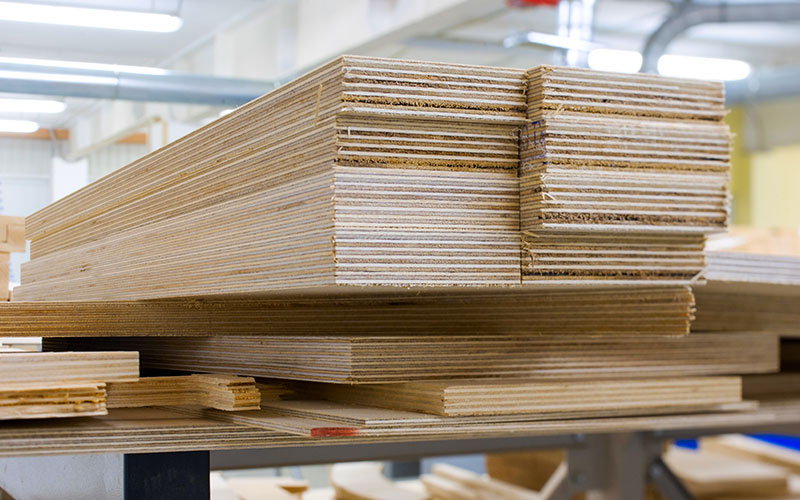
Every supplier claims to offer the best particle board in India — but few explain what that actually means in technical terms. For architects, interior designers, and furniture manufacturers making sourcing decisions, understanding the factors behind board quality is far more useful than marketing claims. Here's a breakdown of what genuinely separates high-quality particle board from average ones.
Density and Its Impact on Strength
Particle board density directly affects screw-holding strength, load-bearing capacity, and overall durability. Higher-density boards (generally above 650 kg/m³) tend to perform better for furniture and structural applications, while lower-density boards may be suited only for lightweight interior use. A quality supplier should be able to state density specifications clearly, not just describe the board as "durable."
Internal Bond (IB) Strength
Internal bond strength measures how well the wood particles are held together internally — essentially, resistance to delamination under stress. This is one of the most important indicators of long-term durability, especially for furniture that will be handled, moved, or load-bearing over years of use.
Uniform Structure Across the Board
A well-manufactured particle board has a homogeneous structure — no visible knots, grain irregularities, or inconsistent density pockets. This uniformity ensures equal strength in all directions and predictable behavior when cutting, drilling, or laminating.
Moisture Resistance
Standard particle board is not inherently water-resistant, but quality manufacturers offer treated variants with enhanced resistance to moisture, fungus, and termites — a critical factor for humid climates and long-term furniture performance.
Screw and Edge Retention
Boards that hold screws firmly on both face and edge, without splintering or flaking, are significantly more reliable for cabinetry, furniture joints, and fittings that undergo repeated use.
Surface Finish and Lamination Compatibility
The best particle boards accept lamination, veneering, painting, and PVC coating cleanly, without surface defects showing through. This matters particularly for pre-laminated boards used directly in visible furniture surfaces.
Dimensional Stability
Quality particle board maintains its shape and size under varying humidity and temperature conditions — poor dimensional stability leads to warping, which becomes a costly problem after installation.
Manufacturing Process and Quality Control
Automated manufacturing with metal/foreign particle screening, controlled drying, and consistent pressing standards produces far more reliable boards than manual or poorly monitored processes. Ask suppliers about their production setup — it's often the clearest indicator of consistent quality.
How to Apply This When Sourcing
Rather than relying on general claims of being "the best," ask suppliers for specific density figures, IB strength data, and moisture resistance details. Comparing this data across suppliers gives a much clearer picture of actual quality than pricing or marketing alone.
The Positive Chipboards Standard
At Positive Chipboards India, our particle boards are manufactured on automated, quality-controlled lines — from raw material screening through moisture control, gluing, and pressing — to consistently meet the density, strength, and finish standards outlined above. We supply both plain and pre-laminated particle boards across a range of thicknesses, built for durability in real-world furniture and interior applications.
Reach out to Positive Chipboards India for detailed specifications on our particle board range.